Is that inheritance or probate letter a scam?
Not every inheritance letter is a scam; some are real probate notices about a relative's estate. But inheritance is also a favorite scam hook. The safe move is the same either way: do not act on the letter, verify the details yourself, and only then decide.
What does a fake inheritance or probate letter look like?
A letter or email says you may be an heir or beneficiary. A genuine probate notice usually comes from an estate attorney, names the deceased relative and the heirs, cites a specific court and case number, and encourages you to seek your own independent legal advice. A scam version tends to do the opposite: it rushes you, asks for a fee or your bank details to “release” the funds, or claims a distant stranger left you a fortune.
Why does the inheritance scam work?
Inheritance scams combine hope with confusion. Probate is unfamiliar legal territory, so people are unsure what is normal. Add a large sum of money and a sense that acting fast protects your claim, and many will pay a “processing fee” or share account details before checking anything.
By the numbers: the FBI's Internet Crime Complaint Center logged 5,623 complaints in its Lottery/Sweepstakes/Inheritance category in 2025. It describes these as schemes claiming the victim is “receiving an inheritance from a distant or unknown relative,” but must pay fees or taxes to claim it. Source: FBI IC3 2025 Internet Crime Report.
Red flags to watch for
- You are asked to pay a fee, tax, or “release charge” up front. Real inheritances do not work that way.
- The letter asks for your bank account or ID details to “transfer” the money.
- The deceased is a stranger or a vaguely described “distant relative.”
- You are told to keep it confidential or to act before a deadline.
- No verifiable court, case number, or licensed attorney is named, or the named firm is oddly far from the named court.
What should I do if I get an inheritance or probate letter?
- Do not pay anything and do not share bank or ID details until you have independently confirmed the letter.
- If an attorney is named, verify their license with the state bar association, for example the California State Bar at calbar.ca.gov.
- If a court case number is given, look it up in that county court's public records portal.
- Consider retaining your own independent attorney. A genuine probate notice will encourage exactly this.
- Not sure? Photograph the letter and send it in for a second opinion and specific verification steps.
Got a letter about an estate or inheritance? Start a free trial and send us a clear photo. Our AI checks it and emails back specific steps to verify it, and what it found.
Start your free trialSee an example
This is illustrative, not a subscriber submission: we ran a message written to match this scam's real-world pattern through our current system, and these are real excerpts from that check, cropped to the parts that matter, not the full text. For a real reply we actually sent, under our earlier format, switch to the other tab.
Subject: Letter about a relative's estate, is this legitimate?
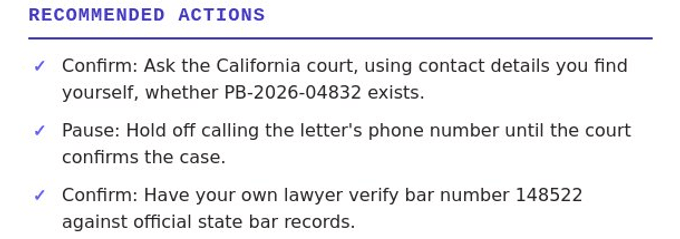
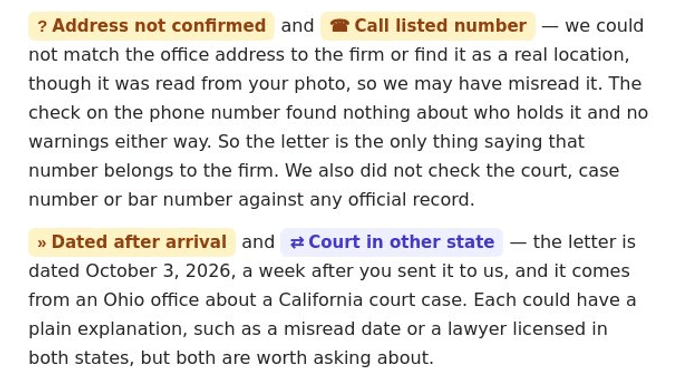
This is the reply we actually sent, quoted as it went out. It was assessed under our earlier verdict format, so it opens with a verdict word. Reports now open with the recommended actions and name what we found beneath them, with no verdict word. We never rewrite an assessment we have already delivered.
Verdict: SUSPICIOUS
A user photographed a legal letter from an estate attorney notifying family members of a court petition to administer a deceased relative's estate at a California county superior court. The letter named the petitioner, listed the heirs, cited a specific case number, and encouraged the family to retain independent counsel.
The letter followed the format of a standard probate notice: no request for money or personal information, and it encouraged hiring an independent attorney. But the service could not independently confirm the law firm or the court case at the time, and the office was an unusual distance from the named court. The verdict at the time was SUSPICIOUS, with two steps: verify the attorney at the state bar, and confirm the case number at the county court.
The family followed both steps. The attorney was real and in good standing; the case existed with that attorney on record. With the case confirmed, the family learned the estate was worth roughly $2.6 million. The service did not guess. It flagged what it could not confirm and handed over two checks that took ten minutes and confirmed a genuine inheritance.
Verify through official channels
- Confirm an attorney's license with the relevant state bar association.
- Look up a court case number in that county or state court's public records portal.
- Report inheritance-fee fraud to the US Federal Trade Commission at reportfraud.ftc.gov.