Is this online romance or investment a scam?
Romance and investment scams are slow-burn frauds: the scammer spends weeks building trust before money is ever mentioned. Each individual message looks harmless, which is exactly why these scams cost victims more than almost any other kind. Here is the pattern, and how to break it.
What does an online romance or investment scam look like?
It begins as an ordinary connection: a dating-app match, a friendly direct message, even a “wrong number” text. The person is warm, attentive, and quick to call you special. They always have a reason they cannot meet in person or video call. After weeks of daily chatting, the topic turns to money: a crypto platform that is “making them great returns,” a sudden emergency, a customs fee, or a guaranteed investment they want to share with you because they care.
Why does the romance-investment scam work?
By the time money comes up, you are not dealing with a stranger; you are dealing with someone you trust and may have feelings for. The scammer has spent weeks isolating the relationship, so there is no friend or family member in the conversation to say “wait.” Refusing then feels like betraying a partner, not declining a pitch.
By the numbers: investment fraud accounted for $8.65 billion in reported losses in 2025 (49% of all fraud losses tracked by the FBI's Internet Crime Complaint Center), and cryptocurrency, often tied to exactly this kind of romance-led “pig butchering” scheme, made up 72% of it. Source: FBI, 2025 Internet Crime Report.
Red flags to watch for
- They profess strong feelings unusually fast.
- They always have an excuse not to meet in person or on a live video call.
- The relationship moves quickly to a private app: WhatsApp, Telegram, Signal.
- They mention an investment, a crypto platform, or “guaranteed” returns.
- Any request for money, gift cards, or crypto, for any reason, however sympathetic.
- They discourage you from telling family or friends.
What should I do if an online partner suggests investing?
- Never send money, gift cards, or cryptocurrency to someone you have not met in person, no matter how long you have been talking.
- Tell a friend or family member about the relationship. Scammers rely on isolation; ending it ends much of their power.
- Do a reverse-image search of the person's photos. Stolen photos often appear on many profiles.
- Treat any “guaranteed” investment as a scam. Guaranteed returns do not exist.
- Not sure? Send in screenshots of the conversation, or a written summary of what happened, before you send anything.
Worried about someone you met online? Start a free trial, then send screenshots or just describe what has happened. Our AI reviews it without judgement and emails you what to do about it, and what it found.
Start your free trialSee an example
This is illustrative, not a subscriber submission: we ran a message written to match this scam's real-world pattern through our current system, and these are real excerpts from that check, cropped to the parts that matter, not the full text. For a real reply we actually sent, under our earlier format, switch to the other tab.
Subject: Got this random text - is this a scam?
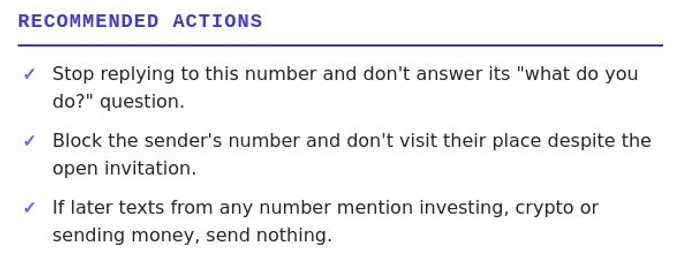
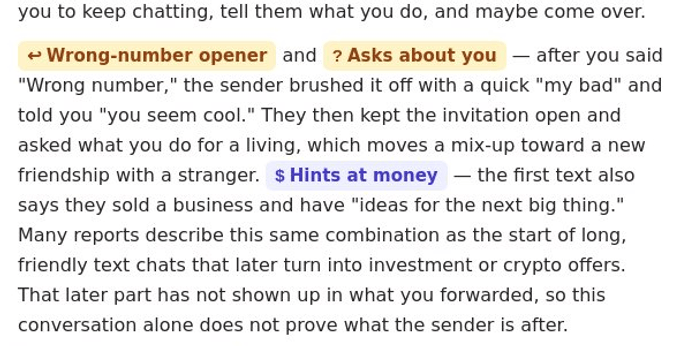
This is the reply we actually sent, quoted as it went out. It was assessed under our earlier verdict format, so it opens with a verdict word. Reports now open with the recommended actions and name what we found beneath them, with no verdict word. We never rewrite an assessment we have already delivered.
Verdict: SCAM
A wrong-number text turned into weeks of friendly conversation. The sender never requested money early on. Instead they shared updates about a cryptocurrency platform that was supposedly earning them strong returns, and eventually invited the recipient to “try it too.”
This is the classic slow-burn structure. The opening message is harmless on purpose; the investment pitch is the real goal, introduced only once trust is established. A friend sharing a “guaranteed” crypto opportunity that you reach through a link or app they provide is a hallmark of an investment scam: the platform is fake, the early “gains” are a display, and any money deposited cannot be withdrawn.
Verify through official channels
- The US Federal Trade Commission publishes romance-scam guidance and takes reports at reportfraud.ftc.gov.
- Report investment and crypto fraud to the FBI Internet Crime Complaint Center at ic3.gov.
- Check whether an investment firm is registered using the US SEC's tools at investor.gov.