Is that Texas Parks & Wildlife license-renewal text a scam?
Short answer: yes.
Texas Parks and Wildlife sells and renews hunting and fishing licenses at tpwd.texas.gov and through its authorized retailers. Never through a text with a link to tap. Right now, a wave of texts is using the department’s name.
Newer guide, 11 September 2026. This page stays as we published it, and it is right about the text it covers. It is no longer the whole picture: we have since checked real messages carrying TPWD’s name that do not fit this pattern, including one whose link really does go to tpwd.texas.gov. For all of them, and a test that works whoever the sender claims to be, read Is that Texas Parks & Wildlife text or email a scam?

See an example
This is illustrative, not a subscriber submission: we ran a message written to match this scam's real-world pattern through our current system, and these are real excerpts from that check, cropped to the parts that matter, not the full text. For a real reply we actually sent, under our earlier format, switch to the other tab.
Subject: Is this text from Texas Parks & Wildlife real?
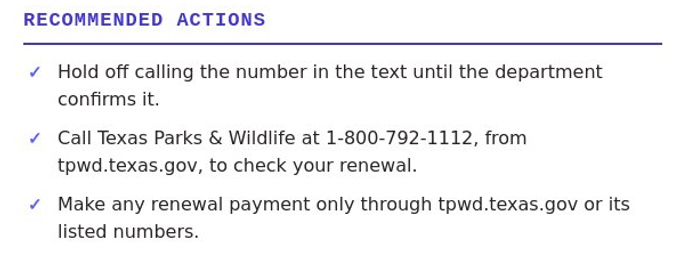
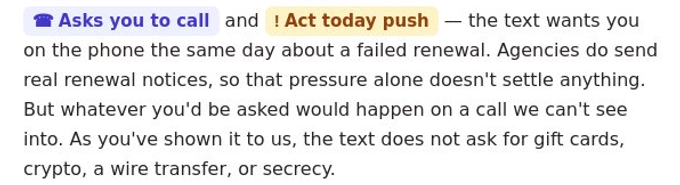
This is the reply we actually sent, quoted as it went out. It was assessed under our earlier verdict format, so it opens with a verdict word. Reports now open with the recommended actions and name what we found beneath them, with no verdict word. We never rewrite an assessment we have already delivered.
Verdict: SUSPICIOUS
Subject: SUSPICIOUS - Texas Parks & Wildlife SMS (#6a108115)
Recommended actions
- Don’t tap
kvy1[.]io/8GQ4bHor call the 888 number from that text. - Buy or renew any Texas license only at tpwd.texas.gov, typed in yourself.
- Use the “Stop or Report Spam” button iOS already offered on that thread.
Investigation summary
You were right to check this one before tapping anything. The text puts a state agency’s name at the front, “Texas Parks & Wildlife Department,” but the link it gives you has nothing to do with Texas state government. TPWD sells licenses through its own tpwd.texas.gov site and authorized retailers; this message routes you through kvy1.io, a three-year-old shortener registered through Gandi with no mail records at all. A real agency notice would send you to a state domain, not an anonymous short link.
I could not see where that link actually lands. The direct probe came back 404, and no page fetch or scanner submission was run, so the destination is genuinely unknown rather than confirmed harmless. That is why this is flagged suspicious rather than called outright: the borrowed agency name and the mismatched link are concrete indicators, but the payoff page can’t be examined. Two details cut slightly the other way: the number has a very low SMS-fraud score, and the message includes “Text STOP to opt-out,” which is bulk marketing compliance language. That pattern fits an affiliate or lead-generation campaign that dresses itself in an agency’s name, which can also end at a third-party page charging fees over the state price, or at a payment-harvesting form. Either way, there is no reason to buy a hunting or fishing license through a text you did not request.
Why does the TPWD license-renewal scam work?
The text borrows a real state agency's name and attaches it to a real, recurring task, timed to land when it hits hardest.
- Hunting season opens in the fall, right when Texas licenses come up for renewal, so it's already on people's minds.
- It plays on plain uncertainty: did I already renew?
- Or the opposite worry: why am I getting this if I already renewed?
- The link goes through a shortener, so you cannot see where it leads.
- TPWD requires a phone number to buy or renew a license in the first place, so a text landing on a real customer's phone is not surprising on its own (confirmed on TPWD's own licensing FAQ).
- That same FAQ never says whether TPWD would ever contact you by text.
By the numbers: people reported losing about $920 million to government impersonators in 2025, up from $866 million the year before. The FTC counts government impersonation among the fastest-growing scam categories it tracks. Source: FTC, “FTC Data Show People Reported Losing $3.5 Billion to Imposter Scams in 2025”.
Is this connected to the 2026 Texas Parks & Wildlife data breach?
There is no proof of a connection, but both the texts and the breach are real. In 2026, TPWD disclosed a data breach at its license-system vendor. It exposed phone numbers and other personal information for more than three million customers. Nothing made public so far, by TPWD or anyone else, ties that breach to these texts. Still, both things are true at once: a real breach exposed contact information, and a real wave of texts is using the department's name. Knowing both is part of being careful. You can read TPWD's official breach notice directly.
Red flags to watch for
- A text or phone call about renewing a license.
- A link that is not tpwd.texas.gov. Often it is a shortened or unrelated web address.
- Pressure to renew “today.”
What should I do if I get a TPWD renewal text?
- Do not tap the link or call the number in the text.
- We called TPWD ourselves. A representative confirmed the department does not call or text about license renewals, and that TPWD is hearing from customers about texts like this one.
- Use your phone's own “Stop or Report Spam” option on the thread. Do not reply, not even STOP. A reply tells the sender your number is live.
- Need to renew? Buy or renew only at tpwd.texas.gov, typed in yourself, or through an authorized retailer, never through a link from a text. TPWD's official Texas Hunt & Fish app can connect and display a license you already hold. It is not a place to buy one: purchases still happen on the website or with a retailer.
Got a text you are not sure about? Start a free trial and send us a screenshot. Our AI checks the message and emails you back what to do about it, and what it found.
Start your free trial