Is that IRS or tax-office voicemail a scam?
If you got a voicemail or robocall claiming to be the IRS, demanding you verify your tax filing, settle a debt, or call back urgently, it is a scam. The real IRS does not cold-call people to threaten them. Here is how to tell, and what to do instead.
What does a fake IRS or tax-office voicemail sound like?
A recorded or live voicemail from an unknown number. A caller, often using an official-sounding but fabricated name, says they are from a tax office, a “tax filing mediation” unit, or the IRS. They tell you your filing is under review or your account has a problem, and you must call back “today,” usually at a number different from the one that called you.
If you call back, the script escalates: a supposed debt, a threat of arrest or a frozen account, and a demand for payment by gift card, wire transfer, or cryptocurrency.
Why does the fake-IRS voicemail scam work?
It pairs authority with fear. Most people do not know exactly how the IRS contacts them, so a confident official voice plus a deadline is enough to start a panic. Once you are afraid, the scammer controls the pace and pushes you to pay before you can check anything.
By the numbers: people reported losing about $920 million to government impersonators in 2025, up from $789 million in 2024, according to the FTC. Impersonating a tax agency is one of the most common versions. Source: FTC, June 2026.
Red flags to watch for
- An unsolicited call or voicemail. The IRS first contacts you by physical mail.
- The callback number is different from the number that called you.
- Threats of arrest, deportation, lawsuits, or a frozen account.
- Pressure to act “today” or “before the review closes.”
- Any demand to pay with gift cards, wire transfer, or cryptocurrency. No real agency does this.
What should I do if I get an IRS or tax-office voicemail?
- Do not call back, not the number on caller ID and not the callback number left in the message.
- Do not give any personal or payment information.
- Block both numbers and report the call to the FTC at reportfraud.ftc.gov.
- If you have a genuine tax question, contact the IRS yourself through irs.gov, using only the contact options published there.
- Not sure? Send in a screenshot of the voicemail transcript, or the recording itself, for a second opinion.
Got a voicemail you are unsure about? Start a free trial and send us the recording, or a screenshot of the transcript. Our AI transcribes and analyzes it, then emails you what to do about it, and what it found.
Start your free trialSee an example
This is illustrative, not a subscriber submission: we ran a message written to match this scam's real-world pattern through our current system, and these are real excerpts from that check, cropped to the parts that matter, not the full text. For a real reply we actually sent, under our earlier format, switch to the other tab.
Submitted: a typed transcript of a voicemail (no audio file)
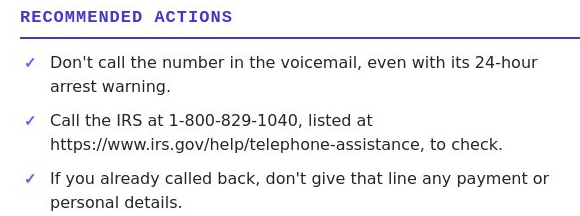
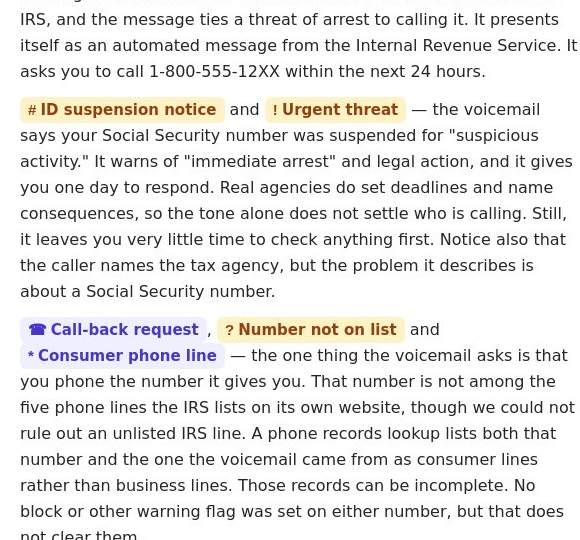
This is the reply we actually sent, quoted as it went out. It was assessed under our earlier verdict format, so it opens with a verdict word. Reports now open with the recommended actions and name what we found beneath them, with no verdict word. We never rewrite an assessment we have already delivered.
Verdict: SCAM
A user sent a screenshot of a voicemail. The caller used a fabricated name, claimed to represent a “tax filing mediation” office, asked the recipient to verify their filing status under time pressure, and left a callback number that differed from the line that had actually called.
No such office exists. The IRS handles US tax matters and does not cold-call people about account reviews. A callback number that differs from the calling number is a classic tactic to route victims to a scam call center. The urgency (“before the review cycle concludes,” “call back today”) was designed to force a decision before verification. Calling back would have led to a demand for gift cards, a wire transfer, or cryptocurrency.
Verify through official channels
- The IRS explains how it really contacts taxpayers at irs.gov.
- Report impersonation scams to the US Treasury Inspector General (TIGTA) and to the FTC at reportfraud.ftc.gov.
- Look up any agency's real phone number yourself, and never use a number from an unsolicited voicemail.