Product update
“Safe” didn’t mean what we thought

Every check we’ve ever sent back used to lead with one word. Scam. Suspicious. Safe. Or, when the evidence ran out, unknown. One word at the top, in a colored band, before you read anything else. That word is gone now, and I want to walk you through how we got here, because it took a lot of real messages to teach us what one word can and can’t do.
What the one word was doing
When I designed this, the goal was an answer worth waiting for. So the service does the looking: it follows the links, reads the letter, listens to the voicemail. Then it boiled everything it found down to one word you could act on. Scam, get rid of it. Safe, go ahead. That’s still the right goal. What I didn’t know yet was how much one word could honestly carry.
You learn this lesson from real messages. Safe and Scam sound simple enough to define. Either the person who sent this is trying to cheat you or they aren’t. But look at what we can actually see. We can see what a message does. Where the link goes. What the page on the other end asks for. Whether the web address was registered last week or ten years ago. What we can’t see is who’s behind it or what they want, and nobody can see that from a message. So every time the word at the top said Safe or Scam, it was making a call about a person’s intentions that the evidence could only point toward. Suspicious was the one word that stayed consistent, because all it claims is that something looked off. And the more careful we got about handing out Safe and Scam, the more messages landed in Suspicious. Do that long enough and Suspicious stops being an answer. It’s a shrug with a color on it, and a shrug isn’t worth waiting for.
What we could actually see
So every time the word at the top said Safe or Scam, it was making a call about a person’s intentions that the evidence could only point toward.
Two examples
The poll my dad clicked
My dad got a text inviting him to take a political poll, and he sent it in to be checked. The link went to a real survey page, and the page did what it said: it asked poll questions. Nothing on it tried to steal a password. Nothing asked for a card number. The web address had been around for years.
And it asked him to reply YES to get more polls, which tells them the number is live and someone answers it. It came from a real polling company, one that’s been doing this a long time, and the company did what it claimed. It gathers information about voters. So this wasn’t a scammer.
We called it safe.
Under the rules we’d written, that was the right answer. There were no scam signals, so the word was Safe. And the word didn’t just fail to warn him. It vouched. It took a message that was quietly collecting information and put our name on it.
Here’s what my dad did with that. He saw Safe at the top and went straight from that word to the link in the text and clicked it. He didn’t think about it. That’s the part I keep coming back to. Just because we didn’t find anything malicious doesn’t mean you get to yell Leeroy Jenkins and charge in. And a green Safe sitting by itself at the top of the page is a pretty loud invitation to do exactly that. A check that says nothing is better than a check that says go ahead when it had no business saying it.
The part I keep coming back to
He saw Safe at the top and went straight from that word to the link and clicked it, and a green Safe sitting by itself at the top of the page is a pretty loud invitation to do exactly that.
The nail in the coffin for single-word verdicts
This one made me stop in my tracks. It didn’t even have a trick in it. It was a message from a short-term loan company. A real business, operating lawfully, charging a high interest rate. It matched none of the tricks scammers use, so we called it safe.
I wouldn’t take a loan like that myself. But it wasn’t a scam, so either “safe” or “suspicious” was the only word we had. The honest description was two things at once: a real company, and a high interest rate. A one-word answer can’t hold two things.
Four problems
Once I looked at those two messages honestly, the single word had four separate problems.
We’re not a court
Calling a real business a scam when we’re wrong is an accusation. A one-word answer commits us to one of those every single time, and we only ever had evidence for something smaller.
Safe isn’t harmless
Scam detection means matching a message against the tricks scammers use. A message can match none of them and still be a high-pressure pitch, or a political blast with a form on the end that collects your details, or the first quiet step of something that only looks bad three messages later. “Safe” flattened all of that into “nothing to see here”.
It caused real harm
Not in theory. My dad clicked because we said it was fine and I’m not calling high interest Safe.
The word was about the sender
This one took me longest to see, and I think it’s the real root. “Safe” and “Scam” are claims about the sender. What we actually do is look at the message. Those are different jobs, and we’d been doing the second one and announcing the first.
What you get now is better
Open a check today and the first thing you see is what to do. The steps. Don’t click this link. Go to your bank by typing its address yourself. Delete it. Whatever fits that message. That’s the headline now, because honestly it always should have been. A word never told anyone what to do next. The steps did.
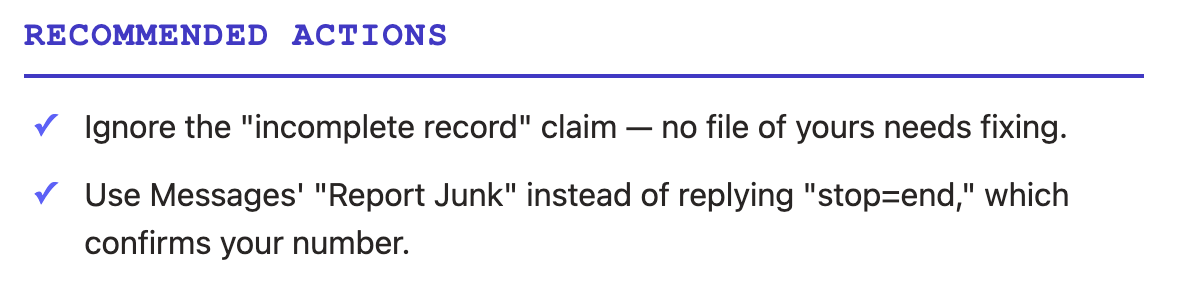
Right under the steps is the investigation summary: plain language that walks through what we actually found in the message and why it points the way it does.

The steps are written as advice to you, “Don’t hand over your credit card details here” is something we can stand behind.
And when we can’t establish something, it says so. Our AI can be wrong. It can miss something real, and it can flag something harmless. That was true before and it’s true now. The difference is that now the answer shows its work, so the answer isn’t one word carrying all the weight.
Why the old checks aren’t being changed
If you look back at a previous check, it still says the old word. That’s on purpose.
An assessment is a record of what we told you on the day we told you. If we went back and quietly rewrote it, you’d have no way to know what you actually acted on. So old checks keep their original word forever, our guides will get an update with the old versions still accessible.
The short version
We refocused the service to show you what we found and what to do about it. If a check ever looks wrong to you, tell us. We’d rather hear it than have you find out the hard way.